
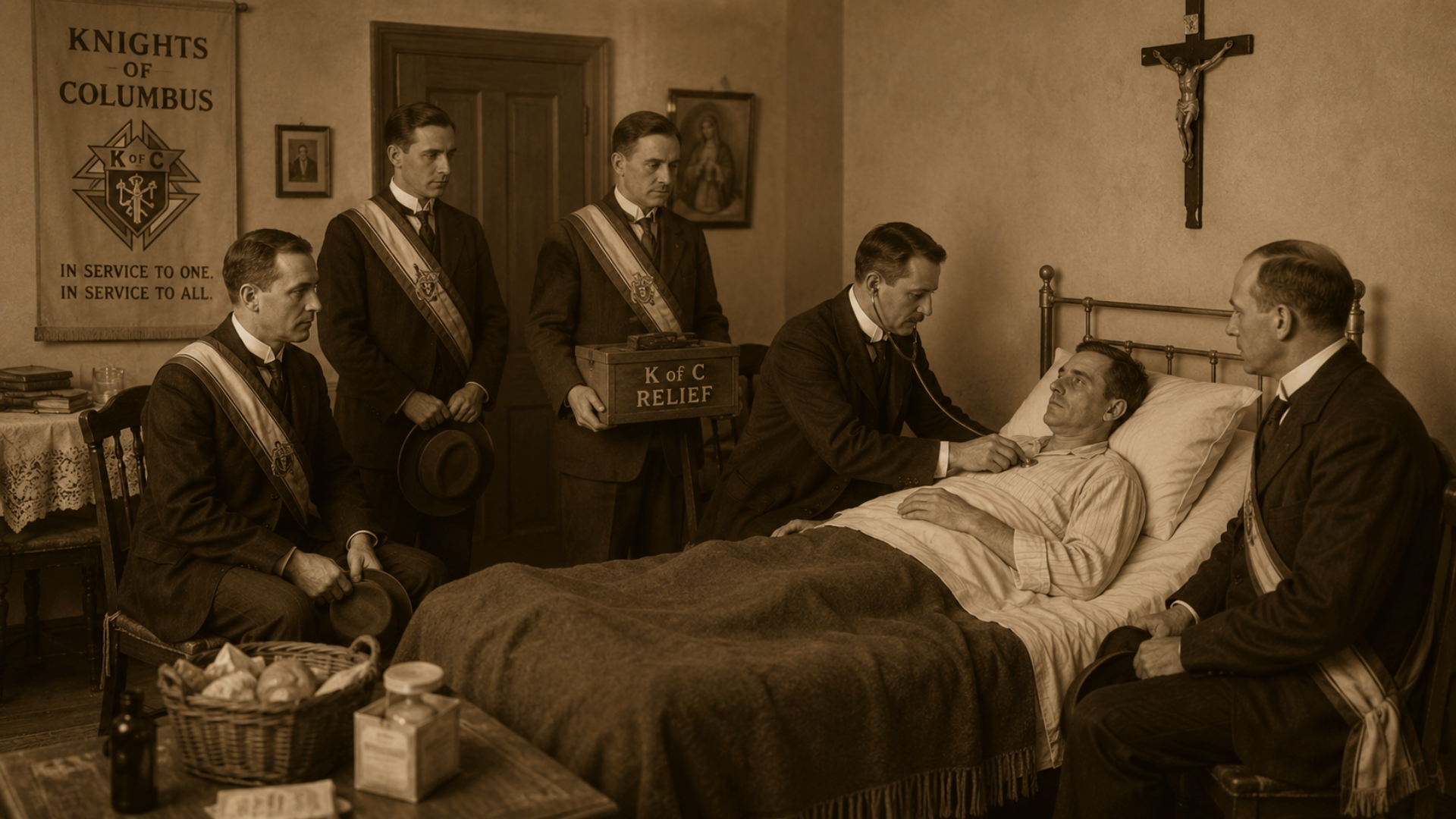


Before Medicaid, Idahoans who needed medical care and lacked the means to pay for it relied on a number of alternatives: friends and family, charitable care from physicians, church networks, mutual aid societies, and community organizations that knew their neighbors by name. Fraternal orders — the Odd Fellows, the Elks, and the Knights of Columbus — were not simply social clubs. Providing mutual aid to members in illness, injury, and hardship was among their central purposes. By the early 20th Century, such societies enrolled roughly one-third of adult American males and delivered meaningful benefits and support grounded in reciprocity and local accountability.
These institutions were real, and they mattered. Yet they had clear limits. Medicaid was created in 1965 in part because politicians concluded these gaps had become unacceptable.
Any serious evaluation must hold both truths simultaneously: the program addressed genuine needs in some places while displacing or accelerating the decline of community-based support that carried real value.
The question of what was lost in that change and its causes has received almost no serious attention in the Statehouse. That is a gap worth filling.
Before asking what Medicaid replaced, it is worth asking what problem it was actually designed to solve and how confidently anyone knew the scale of it. Politicians respond to visible hardship and constituent pressure more readily than to precise data. Whether pre-Medicaid gaps were catastrophic or merely visible enough to become politically actionable remains a question the historical record has not cleanly settled. This ambiguity matters. Programs built on an assumed scale tend to expand to match the assumption.
The decline of mutual aid societies is not primarily a Medicaid story, but government policy played a more direct role than is commonly recognized. Many fraternal orders had already begun declining by the 1920s and 1930s amid the Great Depression, competition from commercial insurers, and cultural shifts. Early public welfare programs — mothers’ pensions, workers’ compensation, and especially New Deal expansions such as Social Security — started substituting for the sickness benefits, orphanages, and old-age support that fraternal orders had long provided. Restrictive state insurance regulations further disadvantaged their mutual models.
Compounding this, New Deal-era and wartime wage and price controls prevented employers from raising cash wages. In response, employers began offering health insurance and other fringe benefits as a way to attract workers. These benefits received favorable tax treatment, locking in employer-sponsored group insurance as the dominant model.
What began as a wartime workaround became a permanent structural shift — one that moved health coverage away from local, reciprocal, community-based arrangements and toward large institutional systems. Medicaid arrived in 1965 amid this longer transition and reinforced the pattern.
But context does not close the case. When government becomes the default provider of a service, it can reduce both the necessity and the moral urgency that once sustained voluntary institutions. Hospitals today deliver measurably less charity care in states with broader Medicaid coverage precisely because public programs have substituted for it. Whether and to what degree this dynamic weakened neighborly responsibility in Idaho communities is an empirical question that warrants rigorous examination rather than mere assumption.
If the postwar decades changed how Americans relate to one another, we should ask whether public policy has reinforced that isolation and what we should do or not do to counteract it. We must choose what kind of community we want. The current structure tells us that neighborly responsibility belongs mainly to program administrators and politicians. The alternative is a system that keeps the moral question alive, where compassion is not fully outsourced but actively supported by families, local institutions, and voluntary associations.
That is not an argument against helping people who need help. It is an argument about who does the helping, how, and what is lost when the default answer is always the same bureaucratic mechanism.
What Medicaid pays for — and what it conspicuously does not — shapes the services Idahoans actually receive in ways that have gone largely unexamined. That will be the subject of the next installment.