


Idaho spent around $17.6 billion in fiscal year 2025 (FY25), with $4.62 billion of that spent on what are called continuous appropriations. This amounts to roughly a quarter of the budget, and it was about the same amount as all expenditures of federal funds ($4.94 billion). As opposed to the regular appropriations process, where the Legislature fixes a specific dollar amount in an annual appropriation, continuous appropriations authorize agencies to spend money within a fund without an annual dollar cap. These are often created in statute, and spending is determined by cash flow into these accounts rather than appropriated directly.
This type of appropriation mechanism has its uses. In fact, much of the $4.62 billion is bond servicing, intragovernmental payments, and pass-throughs for things such as the tax rebate fund and transferring state sales tax to local entities based on set statutory formulas. There is, however, a subset of these expenditures that do not fit neatly into the purpose for which continuous appropriations were designed. These are funds where the spending is discretionary, variable, and policy-driven, what I call “Elective Continuous Spending.”
This category amounts to around $800 million annually and, as we will see, is growing much faster than other types of funding. This type of funding is far more amenable to annual appropriation, yet the Legislature funds it in a continuous manner. One of the great difficulties with continuous expenditures is that they lack sufficient oversight and legislative controls. They are set up to be forgotten, and often are. This creates a convenient, sometimes fully off-budget location where spending can be hidden and then forgotten.
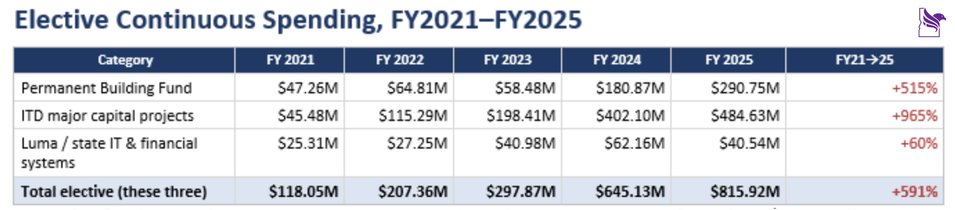
Examples of this kind of spending are numerous and substantial. The Permanent Building Fund distributed $290,753,400 for construction, alterations, and repairs in FY25. The Idaho Transportation Department funded improvement and expansion projects to the tune of about $485 million. The Luma statewide accounting and ERP system totaled $40,540,300 across the State Controller’s Office and the Office of Information Technology Services (OITS). These are all the kinds of investments for which the Legislature ought to appropriate funds annually. Legislators are derelict in their duty to the Constitution of Idaho when they let programs that should be subject to the scrutiny of the annual appropriations process run on autopilot.
Working with this data is fraught with difficulty, but it is possible to reconstruct the growth in expenditures since FY21 for most of the elective continuous spending. For example, the Permanent Building Fund grew from $47 million to $290 million between FY21 and FY25, a 515% increase. Using the few categories that can be tracked reliably across the four-year span, a picture of out-of-control spending emerges. The Permanent Building Fund, ITD major capital projects, and IT services alone have grown 591% over the same time frame.
Compare this with the state budget’s growth in General Funds and All Funds over the same period, and it becomes clear that these hidden funds are growing far faster than the on-budget funding that the appropriation committees have access to. Reports on continuous spending are two years behind actual spending, so the committee only gets a trailing report to work with. They are also relatively new and not comprehensive.
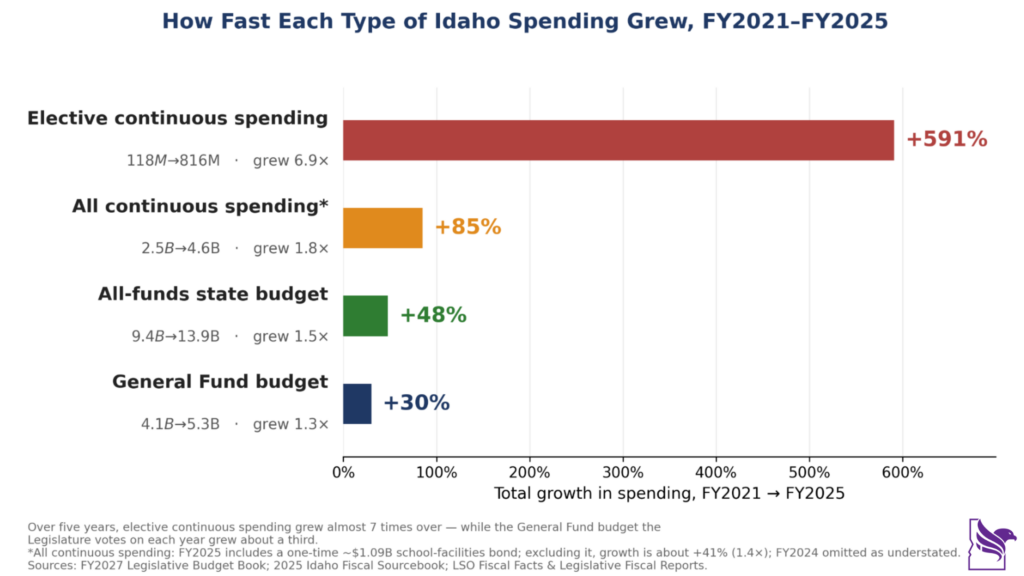
Nevertheless, this data makes it clear that continuous and off-budget spending is growing at a considerable pace and without much legislative oversight. All continuous spending grew 85% over four years, already higher than the visible pieces of the budget. It is especially egregious that the elective continuous categories highlighted are much better suited for annual appropriations than continuous ones, and have grown at an even faster pace. The current framework can only result in obfuscation and a near-complete lack of transparency and oversight.
The Legislature should work to bring the most egregious continuous and off-budget spending under control and should strive to make the data related to continuous spending as transparent and comprehensive as possible. They should do so not only for the good of the state finances, but to make their job easier and to gain accountability over this category of spending. Otherwise, possible impending state fiscal crises will go unnoticed until at least two years after the fact.