
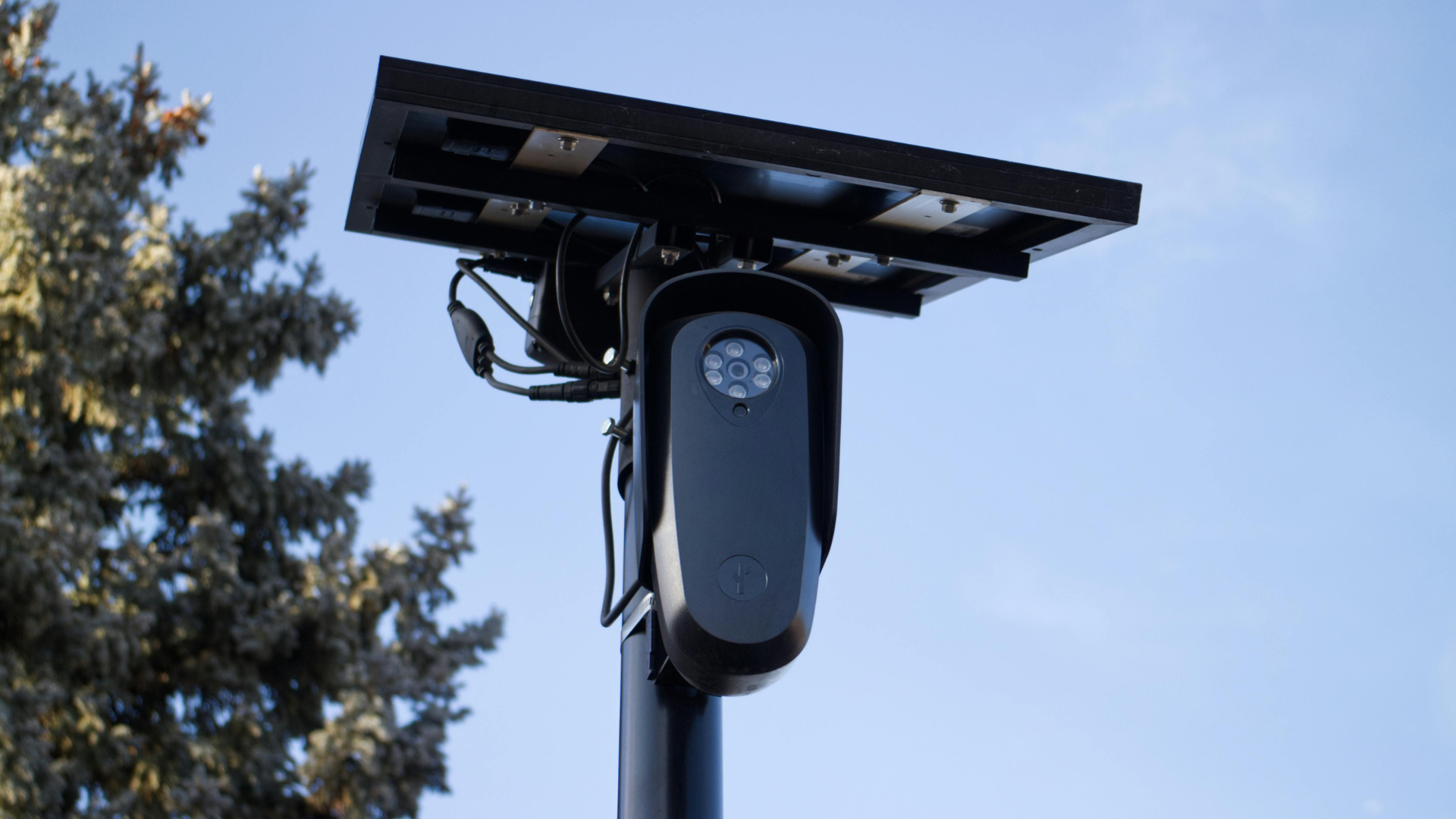


The City of Caldwell intends to terminate its contract with Flock Safety, but not the use of Automated License Plate Readers (ALPRs).
The Caldwell City Council voted in October to switch from Flock to Axon, approving a 10-year contract totaling $6.7 million, according to KTVB. The number of ALPRs will increase from 45 to 65 in Caldwell.
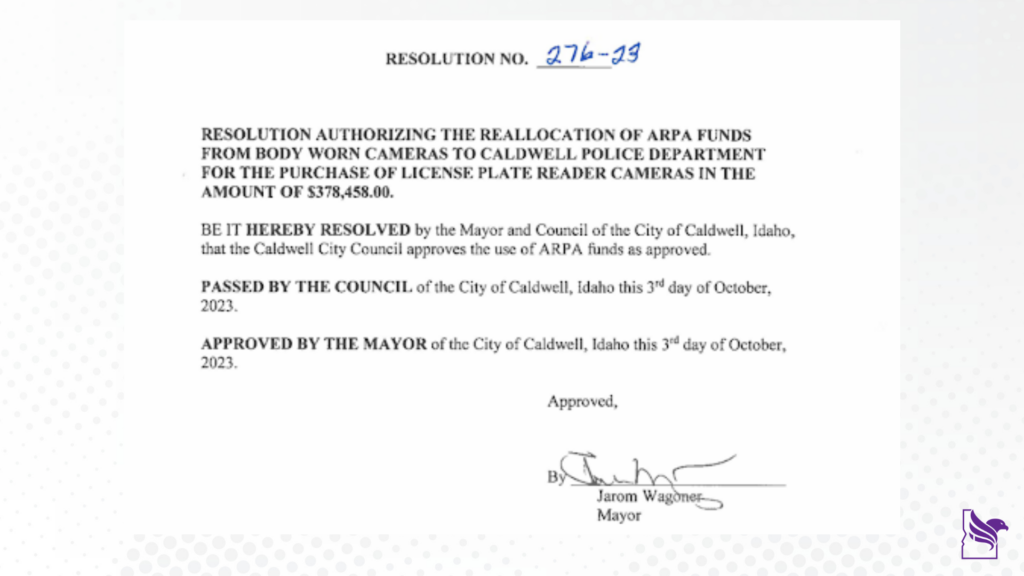
“As many of you know, Caldwell is moving away from its current Flock contracts. I have also publicly expressed my concerns about government surveillance and ALPR technology,” Phillips posted on Facebook prior to the City Council vote.
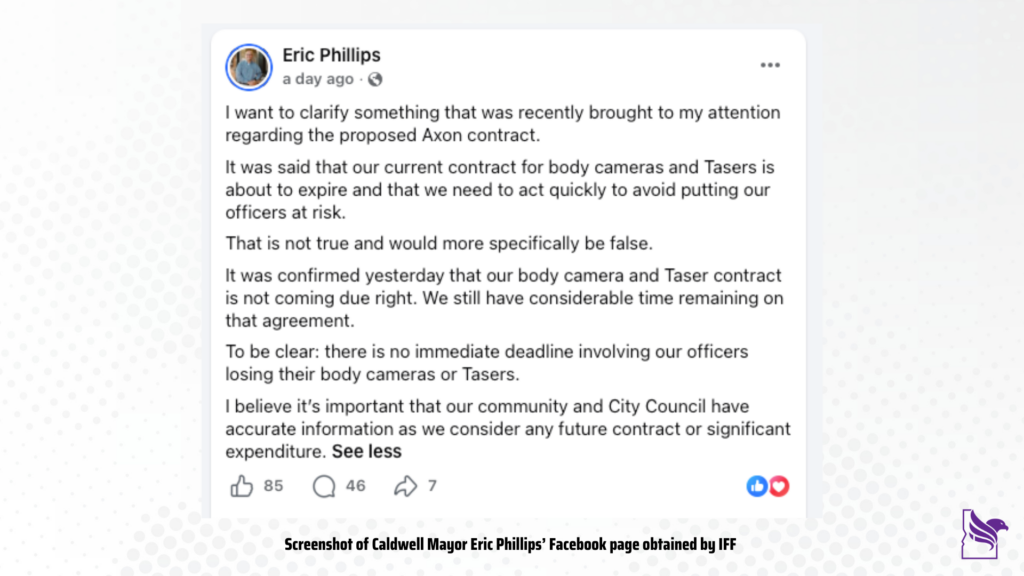
Documents obtained by DeFlock Idaho and reviewed by IFF show the previous mayor, Jarom Wagoner, approved reallocating American Rescue Plan Act (ARPA) funds — in the amount of $378,458 — from body cameras to the Caldwell Police Department (CPD) for purchasing ALPRs in 2023.
The City of Caldwell, in September, confirmed to Idaho Freedom Foundation (IFF) that it would be ending its contract with Flock Safety.
“The City is planning to end its contract with Flock cameras, and the police department is exploring proposals for alternative options,” Public Information Officer Jessica Watts told IFF in a statement.
Axon sells ALPRs along with other surveillance and security products.
IFF acquired emails from the City and CPD concerning discussions with Axon.
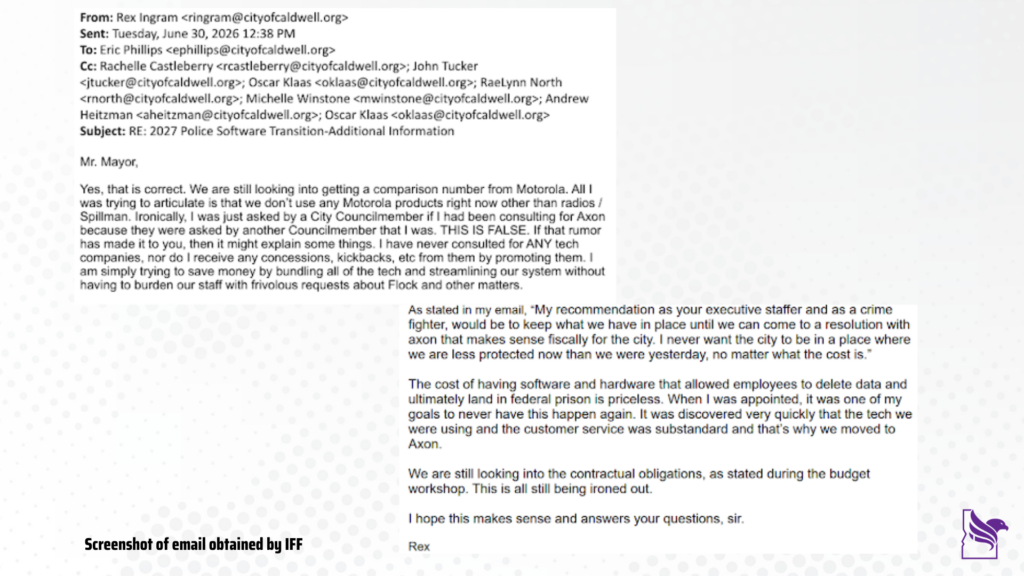
“[M]y team is continuing to negotiate with Axon to get the best deal possible to absorb any costs related to terminating the contracts with Flock Safety,” former Police Chief Rex Ingram, whose last day was Sept. 1, wrote in a June 2026 email.
“Flock has been great and we have no issues with them,” he continued. “The only reason why this came up is because we have some of the contracts that are ready to be renewed and Axon is able to bundle everything with them at this time since we already use several of their products with the exception of the license plate readers.”
He added that since the department’s technology is mostly Axon-based, it made sense to use Axon ALPRs.
The City of Kuna recently removed five Axon ALPRs after Mayor Joe Stear requested they be taken down for the time being. Stear said the Ada County sheriff and the Kuna police chief agreed to remove the cameras pending legislative guidance, 2 Idaho News reported.
“I am simply trying to save money by bundling all of the tech and streamlining our system without having to burden our staff with frivolous requests about Flock and other matters,” Ingram wrote in part.
Perhaps the switch is not about cost, but rather transitioning to a less controversial company. Most people are familiar with Flock, and while Axon has similar ALPR technology, its name elicits less backlash.
Now that Caldwell will be using Axon’s ALPRs, there will indeed be less “frivolous requests” (presumably in reference to records requests) about Flock. But residents deserve to know how their tax dollars are being spent and if the police department is using technology to surveil their vehicles.
Axon, like Flock Safety, utilizes artificial intelligence (AI). Axon advertises its ALPRs as combining license plate recognition with livestreaming. “Axon is the only provider bringing it all together in one ecosystem,” the company said.
Axon offers different ALPR cameras, including Axon Lightpost, which transforms streetlights into “3-in-1 smart cameras with ALPR, livestreaming, and vehicle attribute recognition.” Axon partnered with intelligent-infrastructure company Ubicquia to create Axon Lightpost.
Ubicquia’s name offers some insight into the company’s objective: “Ubicquia, from the latin ubique, means everywhere. Because intelligent infrastructure should be everywhere — and for all,” its website reads.
Flock Safety recently changed its default data retention settings from 30 to seven days. The default retention period for Axon, meanwhile, is still 30 days.
Caldwell Police were also considering Motorola products, according to emails obtained by IFF. “We are still looking into getting a comparison number from Motorola,” Ingram wrote on June 30, 2026, in response to Phillips. “All I was trying to articulate is that we don’t use any Motorola products right now other than radios/Spillman.”
Post Falls Mayor Randy Westlund announced in July that the City would not be using Flock Safety, but he acknowledged the City’s use of Motorola cameras.
Axon purportedly reached out to CPD and sought a decade-long bundled contract with CPD, according to a PowerPoint presentation presented by Ingram and obtained by IFF.

The City of Caldwell has a transparency portal, which includes a (non-ALPR) agreement from Wagoner with Axon. The portal also includes documents regarding its agreements with Flock Safety, as well as a map of Flock cameras in Caldwell.
The city previously confirmed to IFF the CPD was waiting for the 2027 budget to pass before making any decisions about Flock’s future. The City Council approved a nearly $200 million budget for fiscal year 2027 in August.
Caldwell is not the only city where officials are facing scrutiny for allowing ALPRs to spy on residents. Nearby Wilder recently had the opportunity to ban the technology, but ultimately voted against a privacy ordinance.
The Wilder City Council shot down a proposal targeting Flock cameras on Sept. 1, with Mayor Justin Devenberg casting the deciding vote. IFF was in the crowd when the council made its decision.
“The simple fact that a majority of the Wilder City Council refused to educate themselves on the current state of government mass surveillance and technologies while actively subjecting citizens to the very systems shows how fundamentally out of touch they are from the idea of freedom and privacy,” DeFlock Idaho’s Tyler Cain told IFF.
The “Wilder Community Privacy and Data Sovereignty Act” would have banned ALPRs and facial recognition, in addition to regulating data storage. City Council President Cindy Butler indicated during the meeting that some of the proposal’s ideas could be integrated into a separate ordinance the council had been drafting.
Some council members and Wilder residents raised concerns that Cain’s proposal was too broad and could hurt police operations.
“The concerns raised by the council reflect a profound disconnect from the principles of limited government. Subscribing to endless software leases from private surveillance vendors drains taxpayer dollars and surrenders critical data control to outside corporations,” Cain told IFF.
He argued “demanding municipal ownership” and storing records locally is “basic fiscal sanity” and critical to ensuring citizens’ privacy. He further told IFF that mandating council oversight and public hearings before using surveillance technology is not “an obstacle to public safety,” but necessary for accountable government.
“Real privacy protections must have teeth, and protecting our community means closing jurisdictional loopholes so neighboring agencies and third parties cannot bypass local standards,” he told IFF.
The privacy ordinance was originally a petition spearheaded by Cain, and upon gathering enough signatures, it went before the City Council. Although officials voted down the measure, it is reportedly slated for a November 2027 vote.
Cain argued that by dismissing privacy and embracing constant government surveillance, council members abandoned limited government. He praised the two councilmen who voted in favor of the privacy ordinance.
“This was a split vote with the mayor breaking the tie. I commend [Councilmen] Paul Allen and John Bechtel for standing with their constituents. Educating oneself beyond blindly following the ‘experts’ is a single moral requirement we should expect of our elected officials. The process of critical and free thinking seems to have been lost by many in local politics,” Cain concluded to IFF.
If Wilder’s City Council had voted to abolish the cameras, the decision would have put pressure on other municipalities — like Caldwell — to do the same.
IFF recently interviewed Cain on ALPRs. The interview can be viewed HERE.