
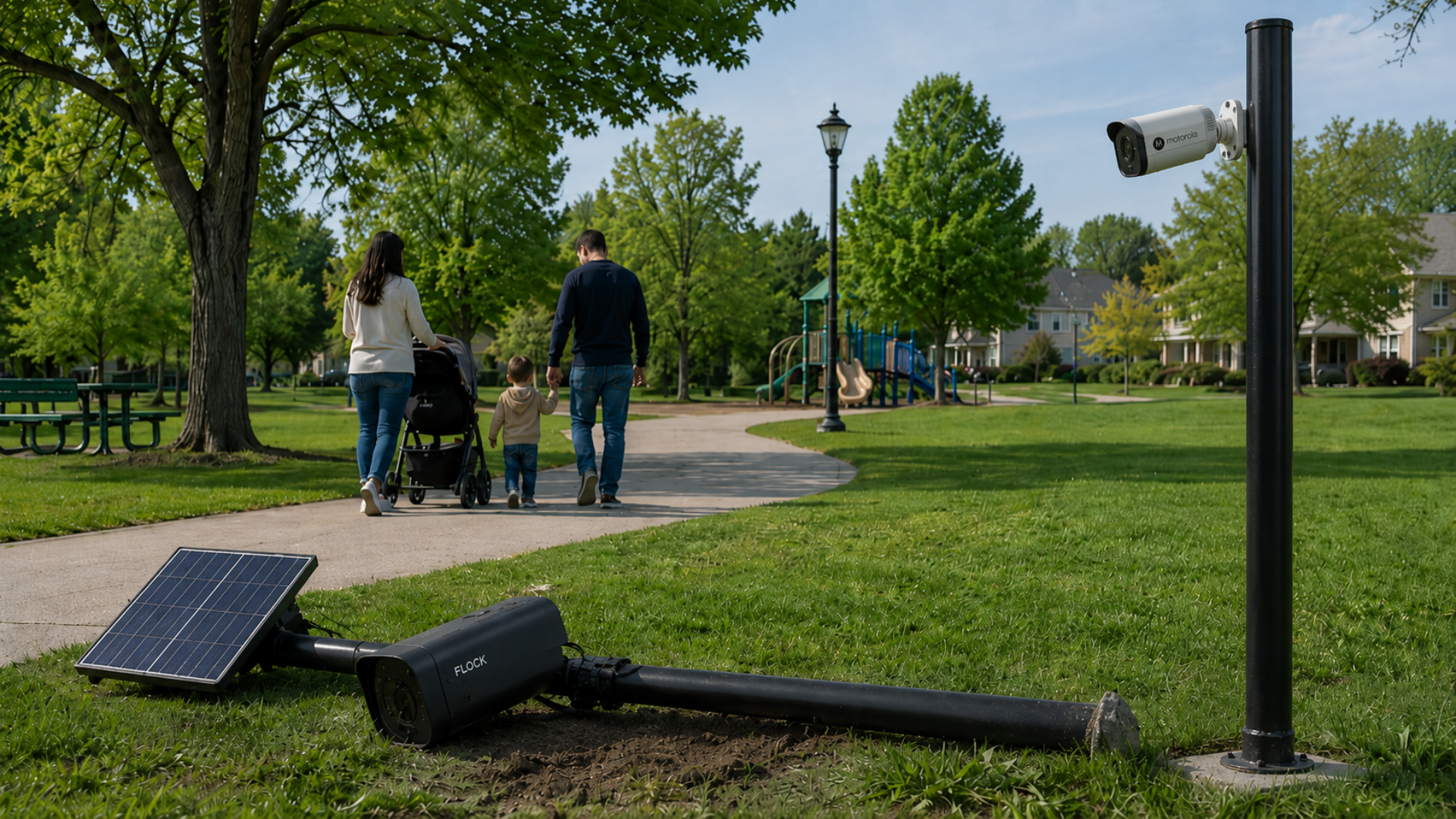


Mayor Randy Westlund recently announced Post Falls will not operate Flock Safety cameras, further vowing the city will never become a “surveillance state.”
He made the announcement on July 24 in response to residents’ concerns about license plate readers, while noting the city operates Motorola cameras. Westlund asserted that Idaho law mandates cities keep the images for at least two years.
“I believe this is wrong, and opens the door to myriad privacy concerns,” he stated.
Westlund did not explicitly state which statute mandates the camera data be retained for two years. Idaho’s Automated License Plate Reader (ALPR) law does not specify how long the data should be retained. Flock’s default setting was 30 days, but recently, the company updated it to seven days.
Flock Safety made several updates to its privacy and data policies, likely in response to nationwide backlash against the cameras.
IFF reached out to Post Falls Public Information Specialist Stephanie Herman to clarify the statute.
“The law being referred to is Idaho Code 50-907(3), which addresses the retention of temporary municipal records,” Herman told IFF.
The law states that “temporary records shall be retained for not less than two (2) years,” although it does not mention ALPR data specifically. Temporary records include “documents or records as may be deemed of temporary nature by the city council,” according to the statute.
The mayor’s announcement comes in the wake of the City of Salmon declaring it would not be acquiring or implementing ALPR technology “at this time.” While the resolution stipulated the city could still consider using ALPRs in the future, the decision not to implement the technology suggests public pushback is working.
Similarly, Clearwater County Sheriff John Smith announced in July the county would not renew its contract with Flock. He said Flock’s cameras failed to show “sufficient operational value.”
The City of Caldwell, a hotspot for Flock, has experienced pushback from residents. IFF reached out to Caldwell about whether the police department will continue to use Flock technology.
“The Caldwell Police Department is still using Flock but waiting for the budget to be approved before they make any decisions on how they proceed for 2027,” Caldwell Mayor’s Office Public Information Officer Jessica Watts told IFF. Caldwell approved its almost $200 million budget on Aug. 11.
Opponents of Flock cameras, and ALPR technology more broadly, argue they violate Fourth Amendment protections against “unreasonable searches and seizures.” The Institute for Justice (IJ) made that argument in an October 2024 lawsuit against Norfolk, Virginia, on behalf of two local residents. The lawsuit claimed Norfolk’s Flock cameras surveilled people’s everyday lives.
IJ argued the cameras constituted warrantless surveillance, and if a city wants to monitor suspicious individuals, then it should obtain a warrant.
“What the city can’t do, though, is watch ordinary people everywhere they go and create a record of their lives without any judicial oversight,” IJ argued.
In January 2026, however, U.S. District Judge Mark Davis shut down the Fourth Amendment claims.
“Federal and state courts analyzing ALPR claims have almost uniformly concluded that neither taking photos of the license plate of a vehicle on a public roadway nor maintaining and querying a database of ALPR photos constitute a warrantless ‘search,’” he wrote.
Still, Flock and other ALPRs are not standard traffic cameras.
Back in Post Falls, the mayor specifically took issue with large databases that track people’s movements in his announcement. He acknowledged the city’s Motorola cameras utilize the National Crime Information Center’s (NCIC) wanted list, and that Post Falls collaborates with federal law enforcement.
While Westlund’s announcement received praise, Tyler Cain’s DeFlock Idaho criticized him for using Motorola ALPRs and pushed back on the mayor’s claim about Idaho law.
“The ‘Two-Year State Law’ excuse is a lie,” a DeFlock Idaho post read in part. “The Mayor claims Idaho law requires them to keep this data for a minimum of two years. WRONG. There is zero state law pertaining to ALPR data retention. They are literally making it up to justify sitting on a massive tracking database. Swapping out a Flock camera for a Motorola one doesn’t magically make spying on citizens constitutional.”
Motorola Solutions states that users of its ALPRs can create “more actionable leads using advanced AI search.” Flock cameras also utilize artificial intelligence.
“We do not and will not track movement of law-abiding residents; the system is configured for real-time notification against active wanted lists only,” Westlund asserted in his announcement.
In response to a comment, the mayor seemed to argue the creation of large surveillance databases is what poses constitutional issues, and not necessarily cameras on public roads.
“It's well-established case law that there's no expectation of privacy on the outside of a vehicle in a public street and thus no 4th amendment issue,” he wrote. “It's the construction of large tracking databases that cross the line and open the door to constitutional challenge.”
Flock cameras and similar ALPRs feed into an interconnected dragnet powered by artificial intelligence, ultimately enabling the surveillance leviathan to swallow up residents regardless of whether they are on a public road or in the comfort of their own home.
There are already documented cases of Flock inaccuracies leading police to pull over innocent people at gunpoint. In Milwaukee, a Flock camera reportedly flagged a vehicle for a homicide, but police pulled over the wrong individual. The Institute for Justice has documented dozens of incidents since 2018 of ALPR-related errors that lead police to target innocent people. In some cases, the drivers were jailed. Many of the errors were the result of officers entering inaccurate information into the ALPR system or “misinterpreting” data.
Recently, a police officer in Florida was accused of using Flock Safety’s camera database over 700 times to surveil his estranged wife’s car, according to an affidavit cited by ABC10.
And in Idaho, the Jerome City Council voted to remove funding for Flock Safety cameras from the 2027 budget. Former Jerome County Sheriff, George Oppedyk, allegedly used Flock cameras to search for his wife’s vehicle, according to KMVT. The sheriff was placed under investigation, the outlet reported, but the Idaho Attorney General’s Office said it could not find “sufficient evidence to prove a crime beyond a reasonable doubt.”
ALPR technology will continue to be abused or misused by those in power. But as certain municipalities have demonstrated, embracing the surveillance state is not an inevitability, and Idahoans can choose to oppose mass surveillance — in whatever form it comes.