

This week is Teacher Appreciation Week across the country, and it prompted Governor Brad Little to issue a press release where he had this to say:
“This is Teacher Appreciation Week, a meaningful opportunity to recognize the people who stand at the front of our classrooms each day, shaping the future of our state.
I am proud that during my time as Governor we have moved beyond words of gratitude and backed up our appreciation with real, sustained investment in education and especially in teacher pay.”
We would be the first to agree that good teachers deserve to be fairly compensated, but we have heartburn with the overall tone of the Governor’s comments.
Teacher appreciation should be focused on what excellence in the profession looks like. Not pay and education spending.
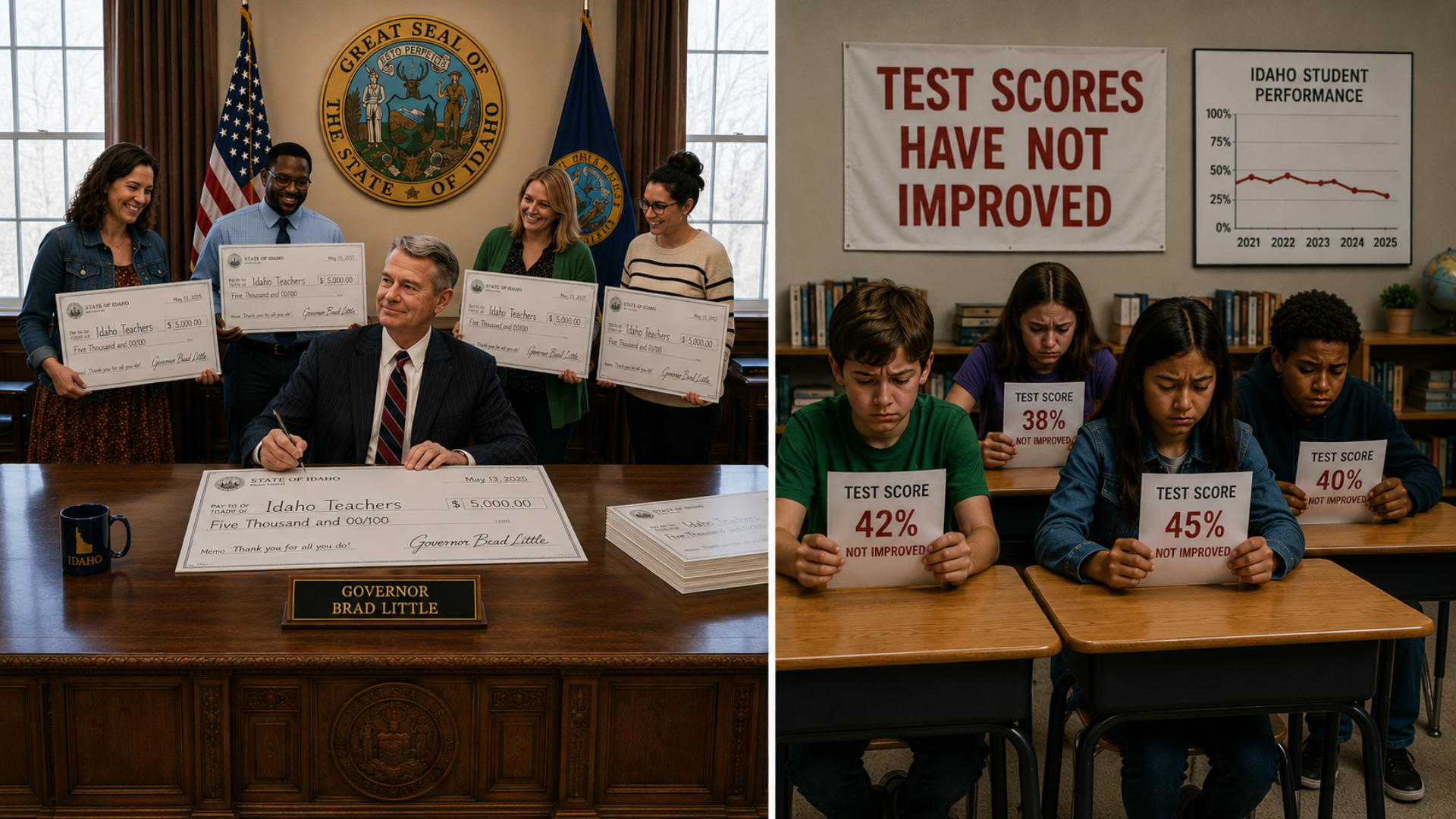
The Governor went on to note that state spending on K–12 had increased 70% since 2019, with teacher pay up 21% since 2021. The Governor also touts the $1,000 bonus paid to teachers, without mentioning that this came from federal COVID funds borrowed from our grandchildren.
As a former factory manager, I know there is always a balance between rewarding employees with higher pay and the realistic understanding that if an enterprise measures success mainly by payroll, it will fail. The problem with the Governor’s obvious pandering is that it sets up the institution of teaching, and in fact the entire apparatus of state government, for failure.
How so?
Very simply, by signaling to teachers (who are school district employees and not state employees, but are largely funded by the state government) and other state employees that they should judge how they are valued by the size of the salary increase and overall appropriation increase for the institution. Thus, it is not about service; it is about money. So, every year going forward, teachers and state employees will claim they are not valued if the state tightens the budget or requires accountability. That essentially yields the entire narrative of government performance to the left, because the only way to expect performance is to spend more and pay more.
A related problem is that teachers are not rewarded based on performance, either their own or that of students generally. Year after year, nearly 100% of teachers receive one of the top job performance ratings: proficient or distinguished. So essentially, teachers are now compensated based on time served and educational attainment, not teaching performance.
All of this is to say that there is a disconnect in the Governor’s reasoning. We don’t dispute his numbers on the funding increases, but we wonder why his opus on appreciating teachers doesn’t mention that student performance hasn't improved commensurately with all this added money. If student performance had skyrocketed, his rationale would make some sense.
Perhaps the Governor is trying to soften the blow of signing House Bill 516, which prohibits taxpayer funding of teachers’ unions. A better way to appreciate teachers, in our view, is to reward outstanding teachers, dismiss poor performers who sully the profession, and reduce micromanagement of teachers and administrative bloat that takes money out of the classroom.