



How will Gov.-elect Brad Little differ from his predecessor? What will win out as Little’s top priority during the 2019 legislative session? Which campaign promises will the new governor keep?
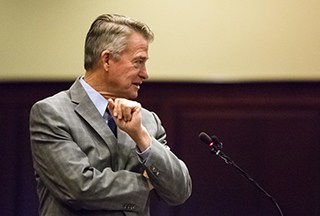
For about an hour Thursday morning in the Idaho Capitol’s Lincoln Auditorium, the Idaho press corps lobbed question after question at Gov.-elect Brad Little. Little, for his part, answered the queries—most of them, at least.
At the press conference, Little, who will drop the “-elect” from his title Friday at noon, offered a few hints as to how he will handle policy matters as the state’s chief executive.
Little’s agenda, which is still under wraps until Monday’s State of the State address, may not impress conservatives, at least given the breadcrumbs the incoming governor dropped to the press Thursday morning.
Below are a few observations.
Little may stand firm on work requirements for Medicaid expansion
Fresh off their Medicaid expansion victory at the polls, progressives are going all in to ensure that Republican lawmakers don’t tinker with the voter-passed initiative. That may not fly in the Statehouse, where lawmakers might add work requirements to the law, following the lead of Arkansas and Kentucky. Work requirements are just that: mandates that able-bodied adults who qualify for taxpayer-funded healthcare under expansion would need to work to receive coverage.
Luke Mayville, the left-wing activist who led the Medicaid expansion campaign, regularly characterizes work requirements as harmful and wasteful.
Little didn’t offer a firm stance on the issue Thursday, but signaled that he wants work requirements on the table for discussion. “We ought to have a safety net. It’s incredibly important,” Little told a reporter. “We ought to have some spring in the safety net.”
For the incoming governor, that spring means providing pathways to gainful employment for welfare recipients.
Grocery tax cuts or teacher pay hikes?
On the campaign trail, Little repeatedly touted his support for repealing the grocery tax, a move that he said would make the state’s tax code more competitive with surrounding states. He also trumpeted his endorsement of a plan to raise teacher pay to as high as $40,000 for a first-year educator. The price tag? More than $52 million, according to most estimates.
The question: Can he do both in a single legislative session, especially when tax revenues are weaker than expected and the economy is, in some eyes, volatile?
Little offered no concrete answers on this, either. But, if push comes to shove, it’s likely that teacher pay hikes will crowd out a grocery-tax repeal. During Thursday’s event, the incoming governor dubbed the pay raises as a “pretty high priority for me.” Plus, Idaho lawmakers cut income taxes last year, and they may have no appetite for another round of reductions, especially in a non-election year.
Idaho high on hemp? Not so fast
Late last year, Congress passed and President Donald Trump signed legislation that legalized hemp cultivation in all 50 states. There’s talk in agricultural circles that hemp is the next big cash crop for farmers.
But maybe not in Idaho. That’s because hemp is a close cousin of the marijuana plant. And many Idaho politicos, including the new governor, give the cold shoulder to anything marijuana-related, even substances that have medicinal uses.
Little didn’t swear off the legalization of hemp cultivation Thursday, but he acknowledged some high hurdles advocates need to remove. One is the governor-elect’s fear that deviants could use hemp to camouflage marijuana trafficking.
“I’m not saying no, I’m saying I want to people to know that’s my hurdle,” Little concluded on the hemp question.
The door is open and it’s up to advocates to convince Little that hemp cultivation is the right choice for Idaho.
Land transfer a no-go under Little
Little ducked and dodged a number of questions during Thursday’s meeting with reporters, but he offered a crystal clear stance on the chance of transferring federal lands to state ownership and management.
“That’s not going to happen,” Little said firmly.
The federal government owns about 62 percent of Idaho, more than 32 million acres in all. Some conservatives, tired of federal mismanagement that often leads to catastrophic summer wildfires and ash-filled skies, have discussed land transfer as a remedy to the problem.
Little rejected the idea and said that discussion takes the focus from where it should be, which is developing better relationships with land users and federal land managers.
Holding schools harmless in funding-formula rewrite
Lawmakers have been toiling for years to rewrite Idaho’s convoluted and complex public schools funding formula. This is an important topic, given that the state spends more than $1.8 billion on public education each year.
The new funding formula could pick winners and losers—that is, some districts would see far more cash under the rewrite, while others would see far less. Little intimated he’d like to protect all districts—”hold harmless” in Statehouse jargon—but said he would weigh that against other education priorities. Lawmakers have suggested phase-in protections for districts that would be hurt by any new funding plan; the protections would drop off after a three-year transition period.
AP Photo/Otto Kitsinger