
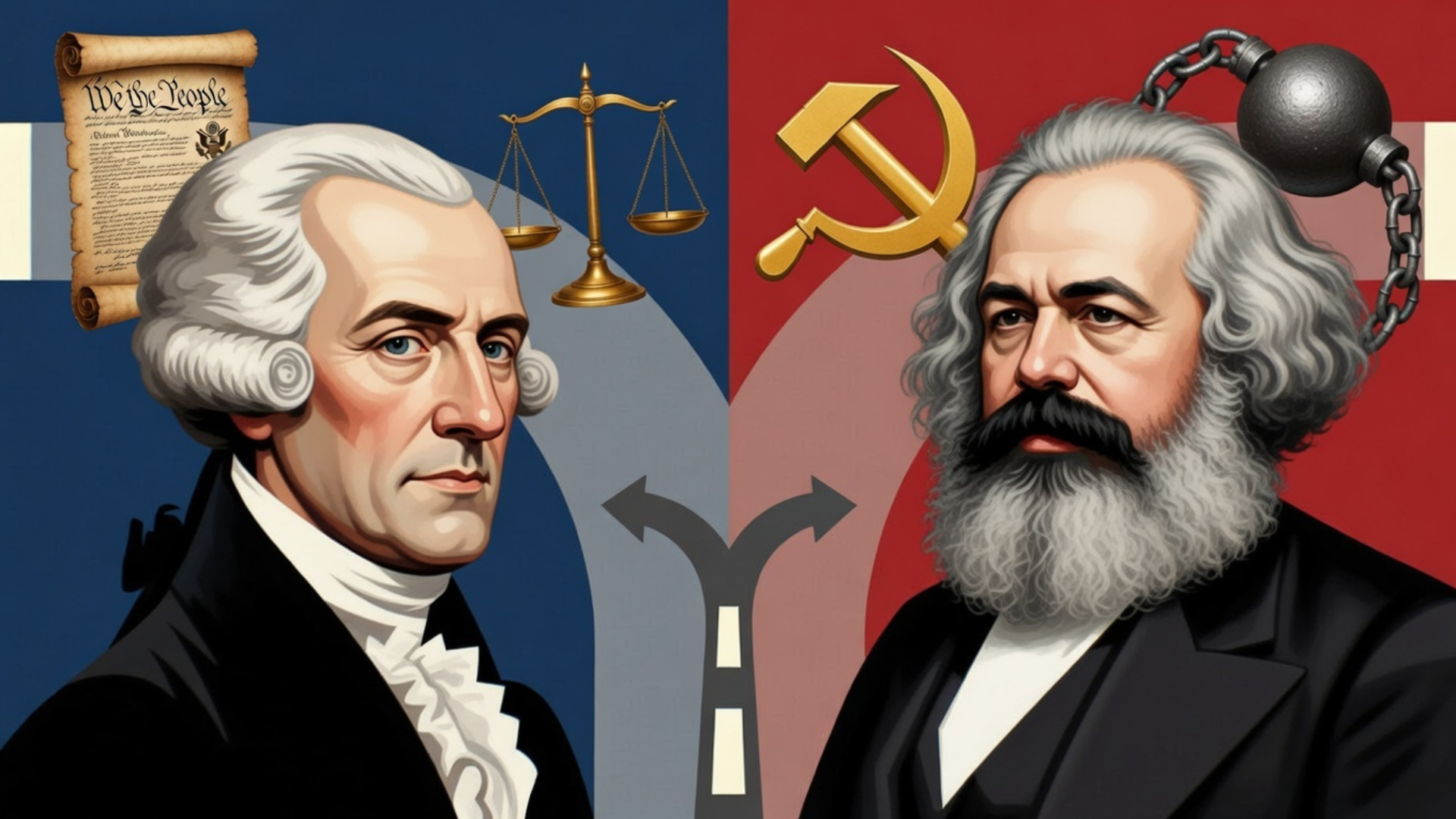


The Idaho legislative session is in full swing, and as lawmakers debate particular issues like education, parental rights, bodily autonomy, judicial reform, regulations and licensure, and budgets, they are actually engaging — often implicitly — in the age-old philosophical dispute about the proper role of government. Lawmakers are daily confronting the question: who should shape the moral and social life of the community — the state or the family? Competing opinions on legislation ultimately boil down to whether a person believes schools, government, and centralized institutions should be at the center of society, or the individual, family, and church come first.
The Western constitutional tradition, which influenced Anglo-American governance, stands in stark contrast to Marxist political theories of society and the proper role of government. Marxism frames the state as an instrument of class rule shaped by struggle and economic relations, while the Western constitutional tradition — drawing from natural law, common law, and religious thought — understands government as a limited institution subordinate to preexisting social structures. These contrasting assumptions lead to profoundly different views of how society should be organized and what role government should play within it.
Philosophical Backdrop:
Karl Marx and Friedrich Engels grounded their political theory in historical materialism, the view that material economic conditions and class struggle determine social institutions, including education and government. Marx and Engels viewed human nature as adaptable, social, and shaped by material conditions, and believed capitalism suppresses human potential rather than unleashing it. In The German Ideology, Marx and Engels argued, “[T]he state is the form in which the individuals of a ruling class assert their common interests.” They believed governments are structures wielded to impose power, shaped by economic dominance rather than neutral protectors of rights.
Marxism understands society to be shaped by material conditions and, therefore, assigns a central role to public institutions — particularly schools, the state, and communal organizations — in reshaping society. For example, education, in Marxist theory, is the primary mechanism through which class ideology is reproduced or transformed, rather than being a tool of moral formation, a mechanism for civic prosperity, and a primary function of the family unit. Marxist thinkers such as Vladimir Lenin and Antonio Gramsci argued the state must actively reorganize education and civic life to overcome inherited bourgeois norms.
During the transition from revolution to a classless society, Marxist ideology places extraordinary responsibility on centralized institutions to reshape economic life, social norms, and education in the service of collective equality. In this tradition, the community is understood primarily through collective structures organized or coordinated by the state, rather than through independent, pre-political structures.
Marxism’s emphasis on institutions for collectivization and societal structure-building is diametrically opposed to Western philosophy, which makes fundamentally different assumptions about human nature and social order. John Locke argued in the Second Treatise of Government that individuals possess the natural right to life, liberty, and property and that these rights preexist the formation of government. The Western tradition holds that natural rights are not created by the state but are merely protected by it. Government arises through consent to remedy the flaws in the human state of nature, and its authority is therefore limited and conditional. Additionally, according to this tradition, the family is not a creation of the state, but a natural institution that precedes political authority.
William Blackstone reinforced this framework in his Commentaries on the Laws of England, describing the common law as a guardian of inherited rights and social customs. Blackstone emphasized the sanctity of property and the importance of legal limits on sovereign power. He believed the law should protect a society grounded on families, churches, and voluntary associations rather than replacing them with centralized rule and administration.
The American Founding Fathers built on these ideas to form a constitutional system designed to restrain government power. James Madison infamously wrote in Federalist No. 45, “The powers delegated by the proposed Constitution to the federal government are few and defined. Those which are to remain in the State governments are numerous and indefinite.” He desired governance to be closest to the people, which would help keep the government limited.
In Federalist No. 51, Madison championed limited government along a grim view of human nature, stating: “If men were angels, no government would be necessary.” In other words, because human beings are fallible, power must be divided, checked, and restrained. Liberty is preserved by dispersing power across competing branches and levels of government, while leaving the vast sphere of ordinary life outside of the state altogether. The Constitution’s separation of powers and federalism were thus “auxiliary precautions” designed to prevent any one institution from becoming the arbiter of moral, social, and economic life.
Madison and the Founding generation assumed most of life would be governed by religion, virtue, and community. Churches would shape moral formation, families would raise children, and local associations would cultivate civic virtue. Government existed to secure the conditions under which these pre-political institutions could flourish, not to replace or control them. Alexis de Tocqueville observed that “democracy in America” was sustained by a robust civil society centered on families and churches, which cultivated moral responsibility independently of government control and protected against “the tyranny of the majority.”
The belief that social order emerges organically from below and is anchored in human nature, tradition, and moral limits, rather than being engineered from above by centralized authority, is central to Western tradition.
What Does This Tell Us About the Proper Role of Government?
According to the Founding Fathers, government is instituted to secure natural rights and ought to derive its authority from “the consent of the governed.” Put simply in a way that highlights the contrast with Marxist theory, government's purpose is to protect equal rights, not provide equal outcomes.
By this, we can confidently understand the proper role of government to be:
This role is supported by certain structural safeguards:
What Does This Mean for Idaho?
Identifying “good” legislation can be difficult, but it is easier when you examine it through the above criteria of whether it is within the proper role of government. Simple questions to ask are:
Policy debates on everyday issues reflect these two competing theories of social order. For example, whether schools are viewed primarily as extensions of state policy or as institutions accountable to families and local communities depends on one’s underlying philosophy of government. “Good” legislation will reflect the understanding that government is not the primary source of moral authority, but rather a restrained protector of liberty.
For the Founders, the preservation and supremacy of pre-political institutions is the most fundamental safeguard against tyranny. They created a republican government predicated on the notion that families would be at the center of society. The conservative notion of society and government holds that society is strongest when it grows from the bottom up, rooted in families, churches, and individual liberty.
Government is not the author of social order, the source of moral authority, or the primary shaper of human character. It is a limited instrument, instituted to secure preexisting rights and to preserve the conditions under which free people and their institutions may govern themselves.
When government moves beyond this role, it displaces the institutions liberty depends on. Centralization reorders society by subordinating the individual, families, and churches to political power. History tells us that even well-intentioned expansions of state authority almost always erode self-governance by transferring responsibility from citizens to institutions. As Tocqueville warned, democratic people are especially vulnerable to a “soft despotism” that relieves citizens of responsibility while quietly consolidating power.
For Idaho lawmakers, the measure of sound legislation is therefore not whether it promises desirable outcomes, but whether it respects the boundaries of governmental authority.
In a constitutional republic, the proper role of government is not to build society, but to preserve the conditions in which society can flourish on its own.