


Every year, parental rights are trampled as hundreds of children are taken from their families in the state of Idaho without due process. What is often presented as “child protection” has quietly evolved into a multi-million-dollar industry in which hospitals, government agencies, contractors, and courts are financially incentivized to separate families.
Under the banner of safety, children are removed, parents are sidelined, and due process is too often treated as an inconvenience rather than a right. The burden of proof is turned on its head as parents are presumed guilty and must prove otherwise. Some call it corruption, others call it a systematic failure.
The families experiencing it call it hell.
At the center of this system are Family and Child Protective Services (CPS) courts, which exercise sweeping authority over child custody, visitation, and parental rights — often without the procedural safeguards found in criminal courts. Parents can lose access to their children without a jury trial and without being convicted of any crime, all based on judicial discretion under a "preponderance of evidence” standard — one of the lowest burdens of proof in American law.
This approach stands in sharp contrast to the principles held by the Founding generation, who understood the family to be the bedrock of a free society. Parental authority was recognized as something existing prior to government itself — rooted in nature and essential to liberty. The Founders believed parents have an inherent right and duty to their children and that liberty could not survive without parents being free to teach principles, virtue, discipline, and responsibility to their children without state interference. As John Adams wrote in 1778, “the foundation of national morality must be laid in private families.” For Adams, strong families were not created by government decree, but by parents exercising responsibility over their own households.
U.S. constitutional law has long reflected this understanding. Although not explicitly enumerated in the Constitution, the U.S. Supreme Court has consistently held under the Due Process Clause of the Fourteenth Amendment that parents have a fundamental right to direct the upbringing, education, and care of their children. In the landmark case, Pierce v. Society of Sisters (1925), the Supreme Court ruled that a “child is not the mere creature of the state” and in Troxell v. Granville (2000), it confirmed that it is “the fundamental right of parents to make decisions concerning the care, custody, and control of their children.” In Troxell, the Court further described this as “perhaps the oldest of the fundamental liberty interests recognized by this Court.” These precedents reflect centuries of legal understanding affirming parents — not the state — are presumed to act in their children’s best interest in matters of upbringing, education, and medical care.
This Western tradition of parental authority as the foundation of society stands in stark contrast to progressive, Marxist ideology that subordinates the family to the state. Karl Marx openly advocated for the abolition of the family, and Friedrich Engels — Marx’s co-author of the Communist Manifesto — argued education should be removed from parental control and placed under communal control. In this framework, children are viewed not as the responsibility of parents, but as wards of society. Echoes of this mindset appear in contemporary political rhetoric, including former President Biden’s 2022 remark, “They’re all our children.”
No. Children do not belong to society nor to the state. They belong to their parents, and barring circumstances of proven harm, abuse, or neglect supported by substantial evidence and due process, children should remain with them.
Yet, the structure of Idaho’s child welfare system often points in the opposite direction. As of 2025, due to the passage of Senate Bill 1108 and Senate Bill 1208, Idaho spent roughly $136 million on child welfare services, with approximately $73.4 million (nearly 54%) of that coming from federal sources — primarily through Title IV-E foster care and adoption assistance funding and Title IV-B child welfare services. These funding streams are largely tied to services provided after removal, rather than to prevention or family preservation.
At the state level, the Idaho Department of Health and Welfare (IDHW) received a child welfare budget increase of more than 20% in 2025, adding dozens of frontline workers and tens of millions in combined state and federal funds. Governor Brad Little also proposed a $9.6 million investment aimed at prevention and system transformation — the largest ongoing increase in state history intended to reform how child welfare operates. Additionally, an initiative coming from the IDHW is working to double the number of foster homes in Idaho from 2024 through 2026.
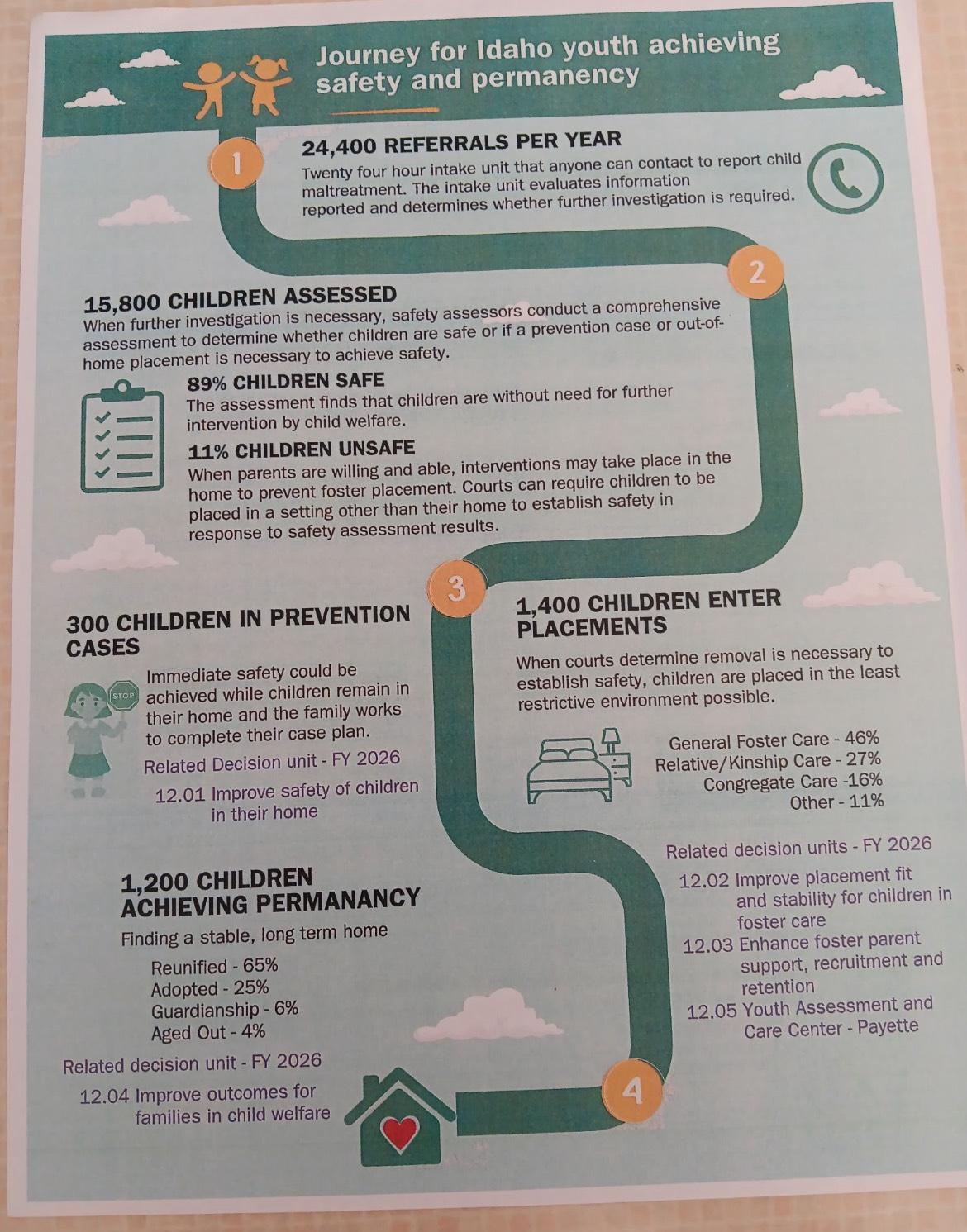
This scale of state intervention is significant. In fiscal year 2024, IDHW received over 24,400 calls alleging child abuse or neglect. Approximately 15,800 of those reports were investigated. In roughly 11% of investigations — nearly 1,700 cases — children were deemed unsafe and removed from their homes or placed into state custody. Many of these cases annually are related to a child’s physical wellness or a parent's medical decisionmaking for their children.
This brings us to one of the most contentious issues arising from the existing system. Parents have come to call it “medical kidnapping” — situations in which children are removed due to disputes over medical decisions or perceived medical neglect.
In Idaho, only law enforcement officers or judges have the legal authority to remove a child from a home. Social workers may assess and recommend, but they cannot independently order removal. Once CPS intervenes in a case, however, the Idaho Child Protective Act grants courts sweeping authority. Judges decide whether a child will remain in temporary state custody, often after rapid hearings, compressed timelines, and complex evidentiary standards. Parents frequently face these proceedings without immediate access to legal counsel.
Even if parents ultimately regain custody, the damage of a child being taken from one or both parents is lasting. Families report their children having severe trauma such as disrupted bonding, anxiety, depression, increased health issues, and psychological wounds. Further, an often overlooked consequence of this process may be divorce as a result of the financial and emotional toll. Children’s lives are dramatically disrupted, and removal causes significant emotional, educational, and psychological instability. Additionally, the financial toll for one or both parents is devastating — homes sold, savings depleted, and crushing debt incurred simply to reunite with their children.
In response to growing public concern, the Idaho Legislature convened the Child Custody & Domestic Relations Task Force in 2025 to examine potential problems within family courts and child custody. The task force heard testimony from parents who reported profound injustices, including children being placed into the hands of abusive parents for alleged financial incentives in the courts, claims that temporary custody orders amount to “legalized kidnapping” when they persist for months without review or resolution, and accusations of “medical kidnapping” without evidence of abuse or neglect.
Though there are reports of medical kidnapping going back decades in the state of Idaho, the term became more widely known with the case of Cyrus Anderson or “Baby Cyrus” in 2022 — the child welfare case in which 10-month old baby Cyrus was physically taken from his mother’s arms and into the custody of the IDHW after claims were made by medical professionals that he was underweight and doctors appointments had been missed. Idahoans were outraged at the scene of a nursing child being taken from his mother without proof of harm, abuse, or neglect and without due process.
The Baby Cyrus case was not an isolated event and the parents who testified at the Child Custody & Domestic Task Force committee relayed similar stories with varying reasons given to them of why their children were taken by officials that were both heartbreaking and disturbing. Additionally, they painted a drastically different picture than the judges, social workers, and CPS employees who testified.
At the Idaho Freedom Foundation, we believe children belong with their parents and the natural family is the best place for them, except in cases of proven harm, abuse, or neglect.
We recommend the Legislature:
We call for greater transparency, higher standards of evidence, and stronger legal protections for families — reforms intended to prevent unnecessary and destructive state intrusion on the family unit.
The American system was built on the premise that liberty begins at home. When government institutions — courts, bureaucracies, or government agencies — treat parents as obstacles rather than stewards, they invert the constitutional order.
Protecting children and protecting parental rights are not opposing goals. As the Founders understood, a free society depends on strong families, not families subordinate to the state.
Reaffirming parental rights is not radical — it is deeply and unmistakably American.