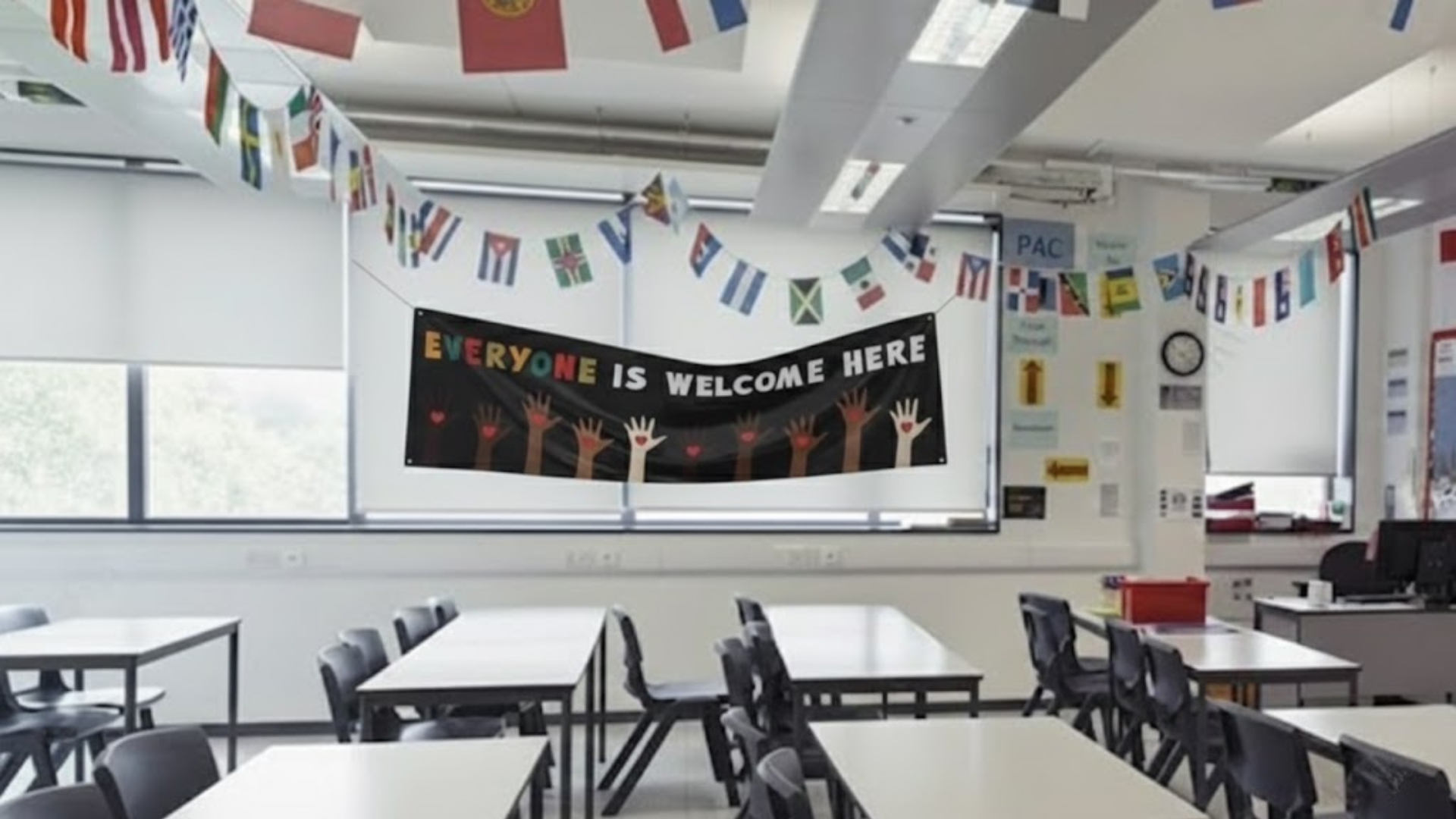


In October 2025, a law enforcement operation at a horse track in Wilder, Idaho, turned into the state’s largest immigration raid, resulting in the arrest of 105 suspected adult illegal aliens. Subsequently, the day following the raid, nearly 20% of students in the Wilder School District were reported absent. This incident reveals how mass immigration is transforming Idaho’s rural communities and simultaneously raises another interesting question: why are the citizens of Idaho subsidizing the education of foreign nationals, let alone illegal aliens?
In 1982, the United States Supreme Court, in Plyler v. Doe, struck down a Texas statute that withheld state funds for the education of children who were not "legally admitted" into the United States and authorized local school districts to deny enrollment to illegal aliens. It also struck down an independent school district’s policy that charged illegal aliens an annual $1,000 tuition fee for each student to compensate for lost state funding. The Court determined that the denial of a free public education to illegal aliens “is utterly incompatible with the Equal Protection Clause of the Fourteenth Amendment.”
The majority's opinion in Plyler holds that states lack any “compelling government interest” to deny enrollment to illegal aliens or charge them tuition for attending public school, but the numbers tell a different story. According to the Federation for American Immigration Reform (FAIR), there are over 21,000 children of illegal aliens in Idaho’s public school system costing the state roughly $245.1 million a year.
Mind you, the Office of Performance Evaluations released a report in March 2025 estimating there is a $82.2 million funding gap in special education. All the while, Idaho’s school choice program is drastically underfunded and currently only covers a fraction of the existing private school population. If Idaho weren’t compelled to spend hundreds of millions on educating foreigners, we would have more resources to adequately fund educational programs for our children.
Beyond this financial burden, there is an even more compelling reason to oppose the Plyler decision on principle. Our nation’s tradition of self-government is predicated on the understanding of society as a social compact, whereby, in the words of John Adams, “the whole people covenants with each citizen, and each citizen with the whole people, that all shall be governed by certain laws for the common good.” This underlying philosophy is evidenced in the preamble of our own Idaho Constitution, which states that “We, the people of the State of Idaho, grateful to Almighty God for our freedom, to secure its blessings and promote our common welfare do establish this Constitution.” The functions of government are legitimate because we have consented to this mutual association to promote our joint happiness. Our system of public, free common schools was established only for the people of Idaho’s “common welfare” — the legitimate benefactors of the social compact and no one else.
In other words, access to a free education is a privilege of citizenship. By eviscerating the distinction between citizen and alien, Plyler v. Doe undermines the very foundation of our republican government. It is one thing to compel a man to pay for the education of his neighbor with whom, as countrymen, he shares a common destiny and on whose wisdom and virtue the security of his liberties depends; it is another to compel the people of Idaho to pay for the education of foreigners whom we have never consented to live among us. The former derives from our duties as citizens; the latter is nothing short of theft.
Our forefathers recognized that the people are only obligated to submit to controversial judicial decisions on matters that are “fully settled.” In response to the infamous Dred Scott decision, Abraham Lincoln laid out a framework for distinguishing settled from unsettled legal precedents. Among the criteria he lists are whether the decision was unanimous, without any apparent partisan bias, in accordance with legal public expectation, or repeatedly reaffirmed by the Supreme Court as good precedent.
By this standard, Plyler is ripe for a legal challenge. The decision was narrowly decided on a 5-4 split of the justices. In his dissent, Chief Justice Burger took the majority to task for employing an “unabashedly result-oriented approach” based on its own “standards of desirable social policy.” Moreover, he observed that the majority's “unique confluence of theories and rationales” was so contrary to any known theory of “principled constitutional adjudication” that he expected it to establish “little beyond the results in these particular cases.” In short, the Chief Justice concluded that the Court’s decision was so egregiously political and contrary to legal public expectation that it did not warrant any meaningful consideration for future cases on questions pertaining to the proper application of equal protection.
Plyler represents a stark deviation from our nation’s legal tradition on the rights and privileges of immigrants. In 1923, the Supreme Court in Terrace v. Thompson upheld a Washington state law prohibiting aliens who were ineligible to become citizens from owning or leasing land, affirming that the Equal Protection Clause did not supercede a state’s “wide discretion in determining its own public policy and what measures are necessary for its own protection and properly to promote the safety, peace, and good order of its people.” Certainly, if a state may interfere in the private business contracts of resident aliens to lease farm land, it can require illegal aliens to reimburse the state for educating their unlawfully present children.
Plyler is also inconsistent with the rest of our immigration law. Foreign exchange students who are legally permitted to attend a public high school must pay the full, unsubsidized cost of education. However, that same student would be entitled to a free education were he to enter the United States illegally. Even more ridiculous is that while it is unlawful to charge tuition to an illegal alien, Idaho would be entirely within its rights to charge tuition to an American citizen from Pullman, WA, for attending a public school in Moscow.
Beyond these considerations, the landscape of K-12 education has changed drastically in the four decades since Plyler was decided in 1982. Among the most significant developments is the growth of charter schools, which now account for nearly 8% of the nation’s K-12 student population. Under Plyler, illegal aliens have a right to enroll in charter schools since they are publicly funded. However, unlike traditional common schools, charters are only theoretically open to every student. Many charter schools use a lottery system to determine eligibility for a finite number of seats. Given that enrollment in these schools is zero-sum, it is justifiable that enrollment should be reserved for American citizens.
Moreover, many states have begun implementing universal school choice programs. It is unclear whether these programs, which are publicly funded and available to all resident students, must also be made accessible to illegal aliens under equal protection. Even if the Court is unwilling to reconsider its major holding, it should at least clarify how its precedent applies to these new sets of facts.
Recently, several states — including Tennessee, Oklahoma, and Texas — have sought to challenge the precedent of Plyler. Unfortunately, none of these efforts has yet survived the legislative process. This upcoming legislative session, however, Idaho has the opportunity to lead out in restoring the integrity of our social compact.
In 2025, Rep. Dale Hawkins and Rep. Steve Tanner introduced House Bill 382 (H382), which would have required school districts to collect and report the immigration status and nationality of every enrolled student in Idaho's public education system. A 2026 version of H382 deserves to be reintroduced and will be essential to gaining a full and accurate picture of the burden illegal immigration imposes on our public institutions. The Legislature should also consider taking bolder action and directly challenging the main holding of Plyler.
Idaho not only has an interest but an obligation to press this issue. Just as the federal government is endowed with the authority to defend the rights of American citizens against abusive state power, so too do the states have the right to defend their reserved sovereign authority against an unjust encroachment by the federal government. As expressed by James Madison, the architect of our Constitution, whenever the federal government engages in a “deliberate, palpable and dangerous” exercise of powers beyond the scope of the Constitution, the states “have the right, and are in duty bound, to interpose, for arresting the progress of the evil, and for maintaining within their respective limits, the authorities, rights and liberties appertaining to them.”
For too long, the people of Idaho have been burdened without their consent with the expense of supporting an alien population by order of judicial fiat. It is high time we reaffirm that the Constitution was not established for the benefit of illegal aliens, but “to secure the blessings of liberty to ourselves and our posterity.”